the challenge
Buying licenses is easy. Changing how a team works every day is not. I saw it in two very different rooms: client teams who had never written a prompt, and my own engineers, who knew the tools but still wrote every line by hand.
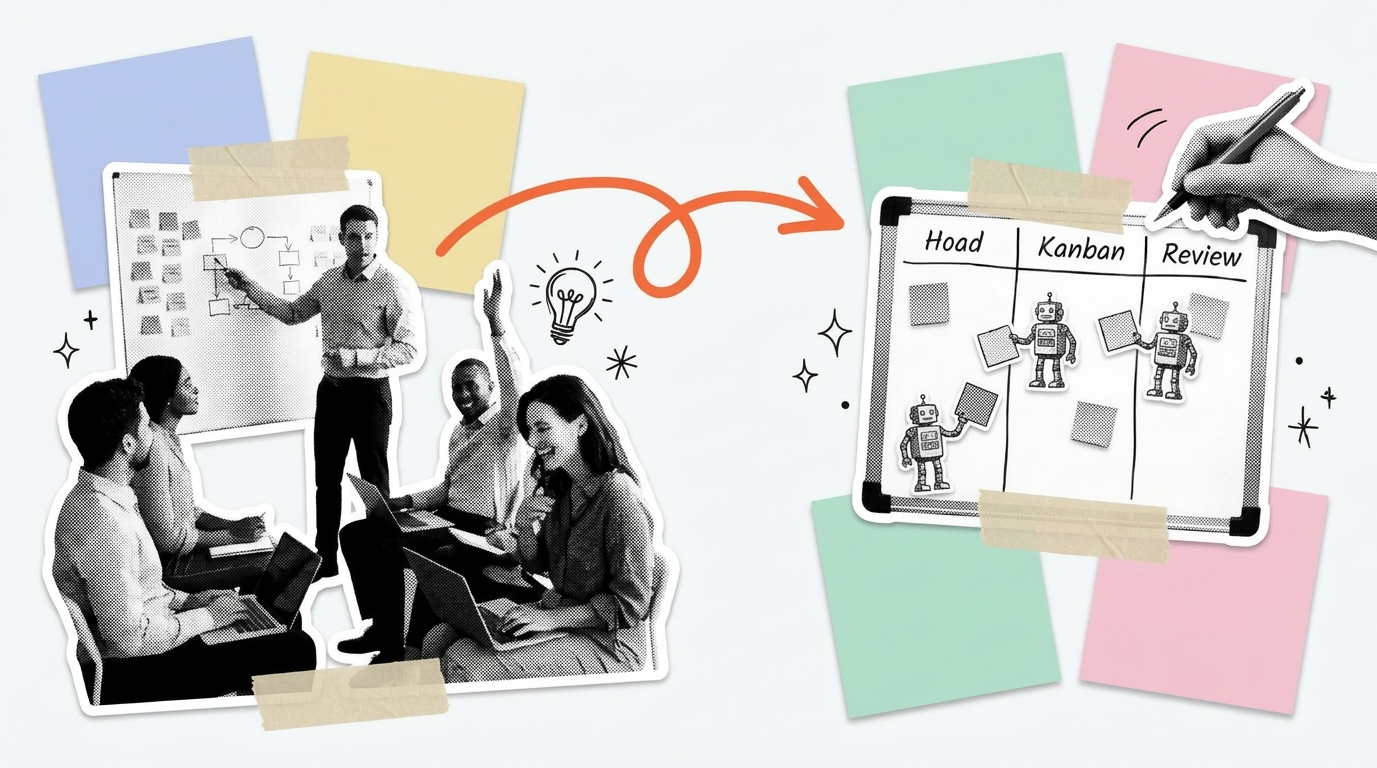
So the program ran on two tracks. One for client teams, to make generative AI part of their daily work. One for engineering, to make coding agents part of how we ship. A single client session could hold daily AI users, people who had tried it once and people worried about their jobs. My engineers were delivering for enterprise clients, so adoption couldn't slow delivery down. Both tracks needed:
- A measured starting point. Each team's level measured, not assumed.
- The right depth. Plain language for non-technical people, real depth for engineers.
- Real work. Exercises on the documents, decks and codebases people touch every week.
- Clear rules. Risk, data and review rules, so speed never costs quality.
- Material that lasts. Prompts, templates, assistants and project scaffolding that outlive the sessions.
my role
Two tracks, two roles. For client teams I co-designed the program and delivered the sessions. For my own engineers I owned the whole track: Innovation Highway, the internal program at BID Company that brought coding agents to the whole team. I wrote the material, the PRD templates and an internal course on agentic coding, and ran live demos on real projects. Then I built the tooling behind it: project templates, CI/CD pipelines and agent skills that start a new project with an automated kanban board.
for client teams
- Maturity assessment. A kick-off with the team lead on goals and data policy, then a survey on skills, tools and the tasks that take the most time. The results shape the plan.
- AI literacy. Hands-on sessions that give everyone a shared vocabulary and a working method, practiced on the team's own material.
- Co-design. The team ranks the ideas collected during training by value and feasibility, describes the best ones on a use case canvas and prototypes them together.
- Roadmap. A closing presentation to management: priorities, owners and the KPIs that will track results.
when the training finds the product
At a film and TV production company, an adoption program for 50 people across departments surfaced the workflow worth rebuilding: how the development team goes from looking for inspiration to pitching an idea.
I designed the architecture and led the team that built a platform for the whole flow. It tracks publishers' bestseller charts every day, uses AI to search reader reviews and synopses for books worth adapting, drafts synopses and creative briefs, then turns each brief into moodboards and social posts with image generation.
for engineers
The goal was not to try a tool, but to change the default way we build.
- A project starts with the board. Agent skills bootstrap a new project together with an automated kanban board. From day one, coding agents can pick up issues from it and work on them alone.
- Autonomy is a property of the issue. Every issue says how much an agent can do alone. Well-scoped issues go straight to an agent, which delivers a tested pull request. Ambiguous ones stay with a person until they're clear.
- People own the review. Agents write code; people decide what ships. Every pull request goes through human review and merge, so accountability stays with us.
the results
Whether the room was a marketing team or a group of senior engineers, the program ended in the same place: AI does more of the work, and people own the outcome. For client teams that meant a method and a roadmap. For my team it meant a new default, where the board feeds the agents and the review belongs to us.
600+
people trained on generative AI
Reach
18
engineers on my team, all building with agents
Adoption